Programmable UPI spend · India

Corporate spend, checked before it moves.
Aumqor makes Xpeazy: the UPI app your field staff pay with, and the console your finance team runs. Company policy is checked before the PIN is asked, so there is no claim to file afterwards.
One payment
One driver. One fuel pump on the Indore–Nagpur highway.
₹1,850
of diesel. Watch what that single payment costs a company today, and what it costs on Xpeazy.
Ravi pays the pump from his own pocket. Then the cost begins.
- The wait
- 12–25days
- to be paid back. 45 at quarter end.
- The cost
- ₹45
- of finance time to process one claim by hand.
- The leak
- 3–6%
- of expense value, lost to duplicates and overcharge.
- The float
- ₹5–15k
- of an employee's own money, out every month.
Seventy to eighty-five percent of field claims still arrive as paper, or a photo in an email. The incumbent alternative is a spreadsheet.
The largest un-automated finance workflow in Indian enterprise.
222 million
times that exact moment happens across Indian enterprise, every year.
₹40,000 Cr
of employee expense a year, still moving on Excel, email and paper.
The reversal
So we removed the claim.
The company pays the merchant directly, from its own pool, on UPI. No card. No reimbursement. No waiting. Nothing to file, because nothing was ever owed.

 Xpeazy · the field app
The same ₹1,850, on Xpeazy.
Employees see spend, never limits. Showing the ceiling only teaches people to spend up to it.
Spend this month, never the limit.
Interactive prototype on demo data. Open full screen
Enforcement, not review
Five checks run before the PIN is even asked.
This is enforcement at the moment of spend, not a policy review three weeks later, when the money is already gone.
Pick a payment and watch it walk the five gates. The company sets the rules; Xpeazy applies them in order and stops at the first one that fails.
₹1,850.00
Bharat Fuel Station, Dewas
-
Pass
Pool funded
The company pool has the money, right now.
-
Pass
Wallet limit
Enforced, and never shown to the holder.
-
Pass
Category allowed
Merchant category read from the QR. Fuel passes; liquor does not.
-
Pass
Time window
Inside the working-hours policy set by the company.
-
Pass
Override status
Charged to a job card, inside its trip budget.
All five checks passed.
ALLOWThe UPI PIN sheet opens next, on the bank's own screen. The receipt is requested after the payment, never before it.
Xpeazy · the console · interactive prototype
Finance stops waiting for month-end.
Every rupee below left the pool in real time, already checked against policy and classified from the merchant code. Nobody is typing this in.
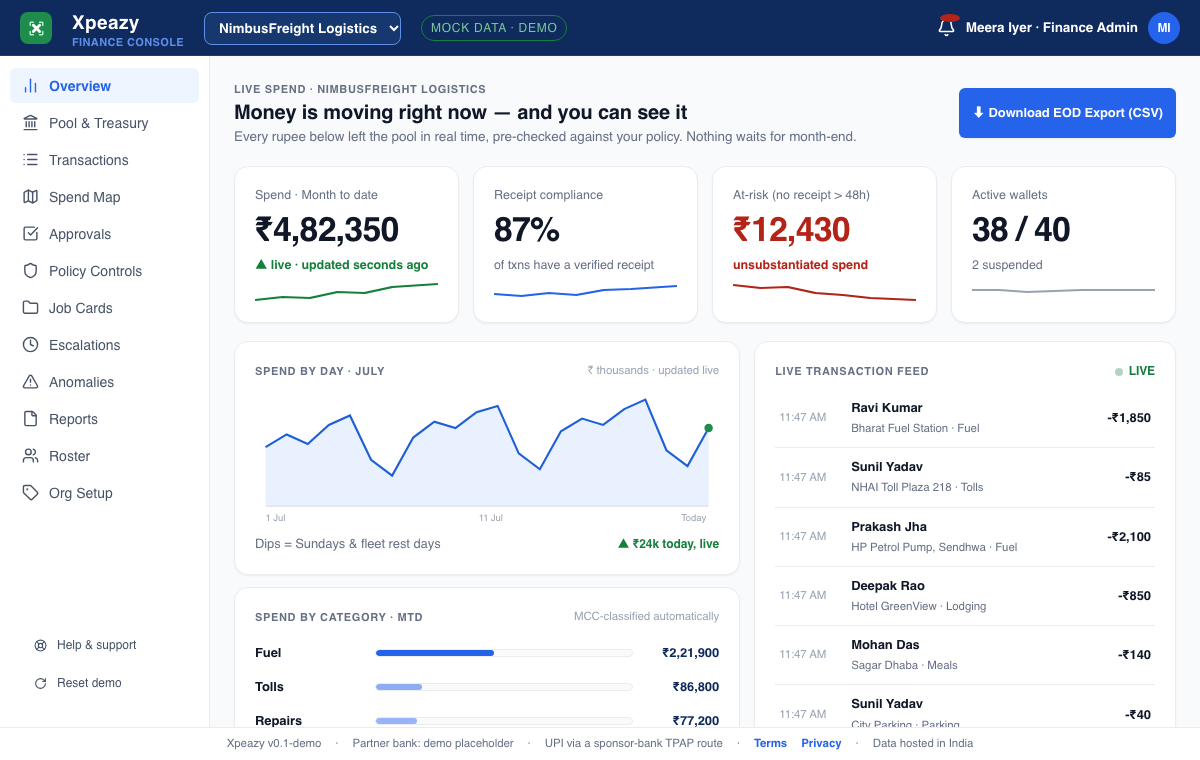
Live spend · NimbusFreight Logistics and VoltServe Field Service, illustrative companies · demo data · Open full screen
Aumqor never touches the money.
Xpeazy is designed around a bank-owned pool: the account belongs to a partner bank, and Aumqor is its technology service provider. Payments execute over the sponsor-bank UPI route that India's largest UPI apps already run on.
Fund once
Thousands of micro-payments draw from a single pool through the day.
On the statement
6
consolidated debits a day, not twenty thousand individual lines.
When the road goes wrong
A tyre bursts near Dewas. The truck is stopped.
-
The ask
Ravi needs ₹2,500 above his limit. An email thread will not move. A ticket queue will not move.
TRIP-4821 · ₹2,500 over the limit -
The approval
His manager gets a secure link, live for fifteen minutes: who is asking, the job card, the reason, the budget already used.
Link live for 15 minutes -
The record
One tap issues a single-use override token, valid for this payment only, logged to the trip's audit trail under a named human.
Single-use · this payment only
Informal approvals leave no audit trail. This one does.
Why the field was never served
The card never arrives.
Every incumbent, corporate cards and every expense tool built on top of them, assumes a piece of plastic reaches the person spending the money. For India's field workforce it structurally never does.
What a card requires
Weeks
- A fixed address for the PIN mailer.
- A courier that finds a driver who is, by definition, not at an address.
- Re-issue on every exit, in a workforce with high attrition.
- Weeks of logistics before a single rupee can be spent.
What Xpeazy requires
Two minutes
- A mobile number the employee already has.
- Verified against the company roster.
- Biometric lock, and the UPI PIN set on the bank's own screen.
- No plastic, no mailer, no courier, nothing to lose or re-issue.
This is not a feature gap. It is the reason the field workforce was never served in the first place.
Stopped at the pipe
Sampling is not checking. Xpeazy checks every payment.
Three to six percent of expense value is lost to fraud and duplicates. Not to a sophisticated attack: to ordinary things, in plain sight, that nobody had time to check.
Sample-based audit
A percentage of claims reviewed, weeks after the money left.
What the sample misses is never found, and what it finds is already spent.
Enforcement at the moment of spend
Every policy check runs before the UPI PIN is even asked.
Anomaly detection runs on every payment, not a sample. Leakage is stopped at the pipe, not found in the audit.
Overcharge
Billed above the agreed rate
Caught by category rules, wallet limits and job-card budget variance, before the PIN.
Duplicate
The same spend, claimed twice
Caught by the duplicate-payment guard at the moment of the second attempt.
Fraud
A merchant or pattern that isn't real
Caught by anomaly detection and payee-identity mismatch, surfaced to finance and never silently blocked.
Leakage is stopped at the pipe, not found in the audit.
The same payment, measured
What it actually changes.
To process one claim
₹45
by hand, todayOn Xpeazy
₹13
about 70% lessTo settle
12–25
days · 45 at quarter endOn Xpeazy
T+2
two working days, where a claim is unavoidableModelled from first principles, not measured. To be validated against the first customer diagnostics.
Same driver. Same pump. Same ₹1,850.
Completely different company.
Built for
Enterprises whose people spend money away from a desk.
- Employee size
- 3,000–50,000. The sweet spot is 5,000 to 25,000.
- Field workforce
- More than 25% of headcount, across 25+ sites and 3+ states.
- Systems
- SAP or Oracle, 15,000–150,000 claims a month.
- Who buys
- CFO-led · Controller-owned · CHRO-amplified · CIO-cleared
- Priority sectors
- Pharma · Insurance · NBFC · FMCG · Logistics · Medical devices
Start here
Start with your own numbers.
A free two-week claims diagnostic on your real data: how many claims, what they cost you to process, and how much is leaking to duplicates and overcharge. Then a 60-day paid pilot.
Or write to hello@aumqor.com